
Adaptive Wealth Intelligence Engine
AI-driven personalization for high-net-worth portfolio management

Summary
The Adaptive Wealth Intelligence Engine empowers wealth managers to deliver hyper-personalized investment strategies while ensuring real-time risk monitoring and compliance. By integrating market data, alternative signals, client objectives, and regulatory constraints, this AI-powered tool automates routine tasks—like client communications and scenario simulations—so advisors can scale high-touch service without sacrificing oversight. Designed for wealth managers, it balances automation with human governance to enhance decision-making and client trust.
Business Problem & Value
Wealth managers face the challenge of delivering tailored advice at scale while navigating complex regulations and volatile markets. This engine solves the problem by automating personalized strategy generation, real-time risk alerts, and compliant client communications. The value? Faster decision-making, reduced operational risk, and the ability to serve more clients with consistent, high-quality advice—all while maintaining regulatory compliance and advisor oversight.
Steps to Build
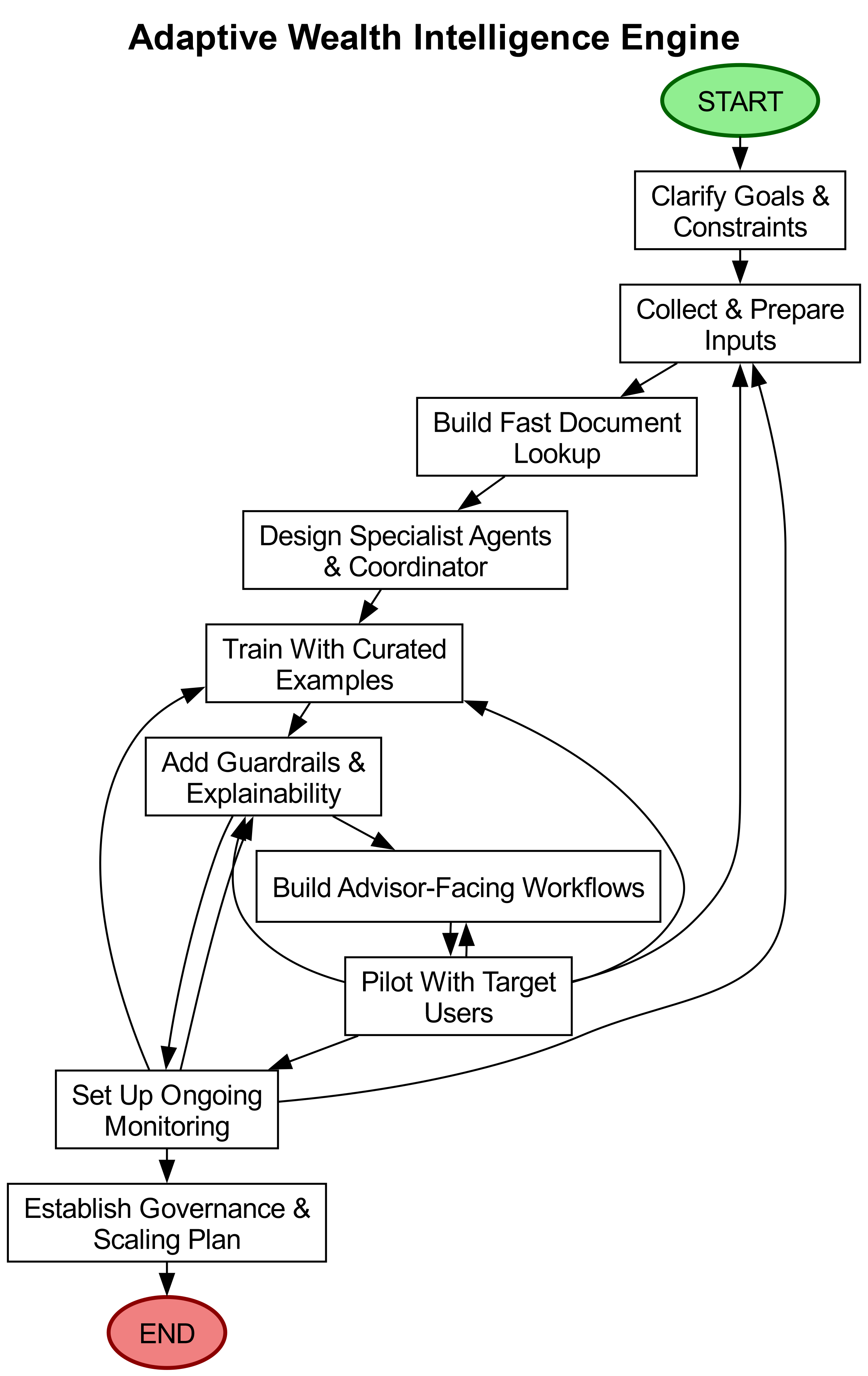
Clarify goals and constraints with stakeholders: Gather requirements from wealth managers, compliance officers, operations, and IT. Define success metrics (e.g., increased returns, reduced risk), scope (client segments, accounts), regulatory requirements, and integration needs (account data, custodians, market feeds).
Collect and prepare inputs: Identify and connect live market data, economic indicators, alternative signals (news, sentiment, events), client profiles, account holdings, and compliance rules. Clean, standardize, and tag sensitive fields to ensure secure handling.
Create a fast document lookup for context: Build a retrieval system to pull the most relevant materials—client goals, regulations, market moves, or research notes—to ensure the AI uses accurate, up-to-date information for recommendations.
Design specialist agents and a coordinator: Split the system into focused agents (e.g., portfolio adjustments, risk scenarios, client messaging) and a coordinator to synthesize their outputs. Keep agents narrowly scoped for transparency and explainability.
Teach the system with curated examples: Provide labeled examples of investment plans, decisions, and communications, reviewed by advisors and compliance teams. Train the AI to recognize acceptable recommendations and phrasing.
Add clear guardrails and explainability: Encode non-negotiable rules (regulatory limits, concentration thresholds) and require plain-language explanations for every recommendation. Set human approval thresholds for high-impact changes (e.g., large reallocations).
Build advisor-facing workflows and automation: Develop a dashboard showing prioritized recommendations, supporting data, scenario results, and draft client messages. Enable advisors to edit, approve, schedule, or escalate actions, with real-time alerts for urgent risks.
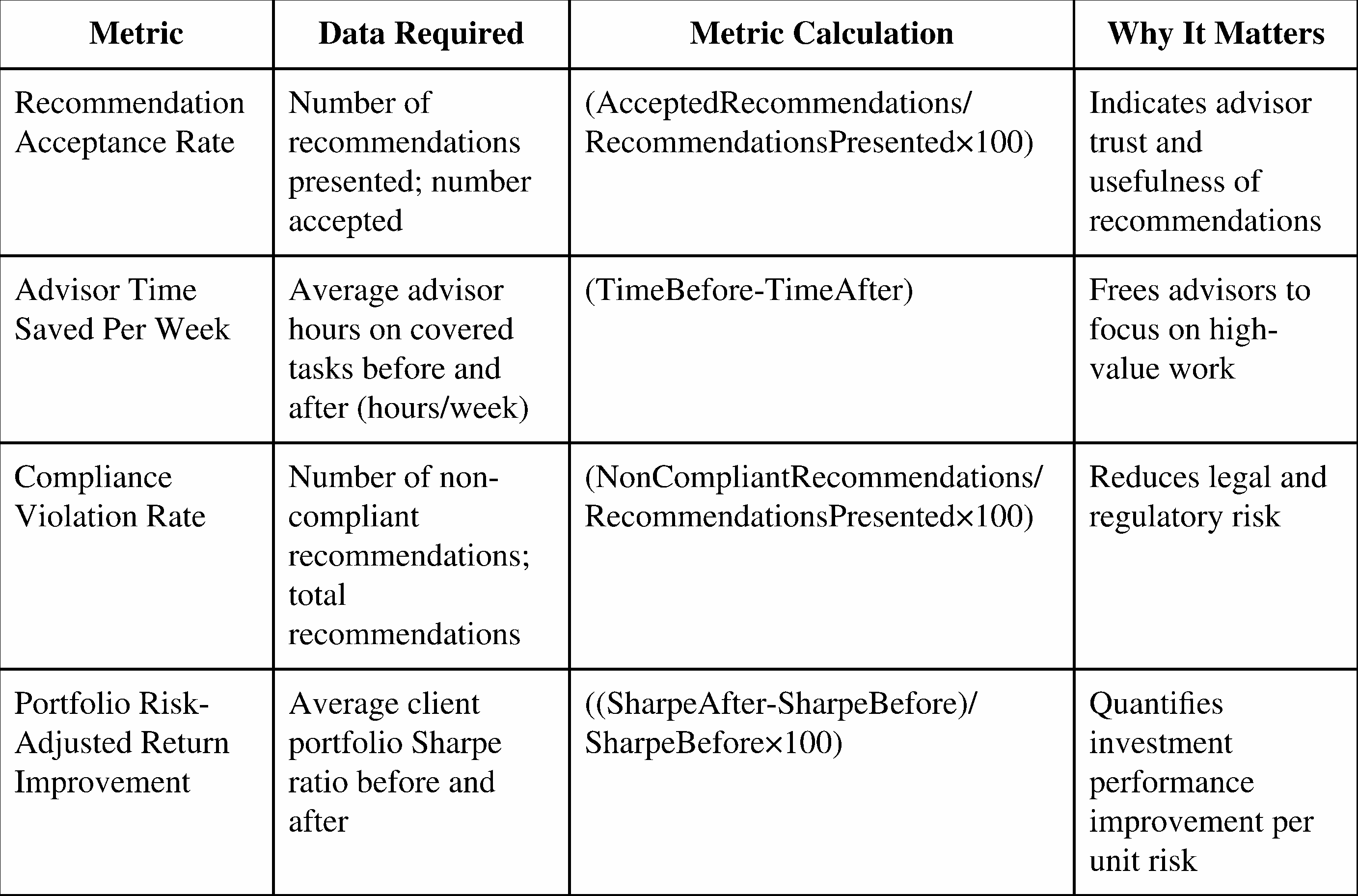
Pilot with target users and iterate: Test the system with a small group of advisors and client profiles. Measure usefulness (time saved, recommendation acceptance), accuracy, and compliance. Refine based on feedback.
Set up ongoing monitoring and maintenance: Track recommendation acceptance rates, errors, and market behavior. Schedule regular updates for data connections, rules, and training examples, and maintain an audit log for compliance.
Establish governance and scaling plan: Form a cross-functional committee (advisors, compliance, legal, security) to oversee changes, incidents, and rollouts. Define training programs and a phased expansion plan for teams or regions.
Impact Metrics
Human-in-the-Loop
Define goals and constraints: Wealth managers, compliance officers, and IT teams set requirements, success metrics, and regulatory rules.
Review and label data: Advisors and compliance teams annotate example decisions to train the AI and validate outputs.
Set compliance rules and thresholds: Humans establish guardrails (e.g., approval requirements for high-net-worth clients or large reallocations).
Approve high-impact recommendations: Advisors review and sign off on critical portfolio changes or client communications.
Pilot and provide feedback: Target users test the system, measure its impact, and suggest refinements.
Governance and auditing: A cross-functional committee oversees ongoing monitoring, incident response, and system updates.
Things to Watch For
Client data privacy and security: Combining sensitive client data with external sources increases exposure risk—implement strict access controls, encryption, and data handling policies.
Regulatory and legal risks: Incorrect or non-compliant advice can lead to violations. Ensure compliance rules are rigorously tested and human approval workflows are enforced.
Model errors during market stress: The system may struggle with rare or volatile market conditions. Maintain fallback plans and require advisor review for high-impact decisions.
Key Takeaways
AI augments, not replaces, advisors: The engine automates routine tasks and surfaces insights, but human oversight remains critical for compliance, high-stakes decisions, and client relationships.
Personalization at scale is possible: By integrating diverse data sources and real-time monitoring, wealth managers can deliver tailored advice to more clients without sacrificing quality.
Governance is non-negotiable: A cross-functional committee and clear audit trails ensure the system remains compliant, secure, and aligned with business goals.
Disclaimer: The idea discussed here reflects a potential application of AI. It is intended for exploration and inspiration. Actual implementation may vary.