
Causal Attribution Studio
Unlock the true drivers of conversions with transparent, actionable insights

Summary
Marketing teams struggle to connect online and offline touchpoints to real business outcomes. The Causal Attribution Studio empowers AI-Powered Marketing Attribution Specialists by combining customer-level data with scalable causal modeling to attribute conversions, simulate budget scenarios, and deliver explainable recommendations—helping justify budget shifts and optimize campaign performance in real time.
Business Problem & Value
Traditional attribution models rely on correlations, not causation, leading to misallocated budgets and wasted spend. This solution identifies which marketing touches actually drive conversions, enabling data-driven budget reallocation, improved Return on Ad Spend (ROAS), and measurable campaign impact.
Steps to Build
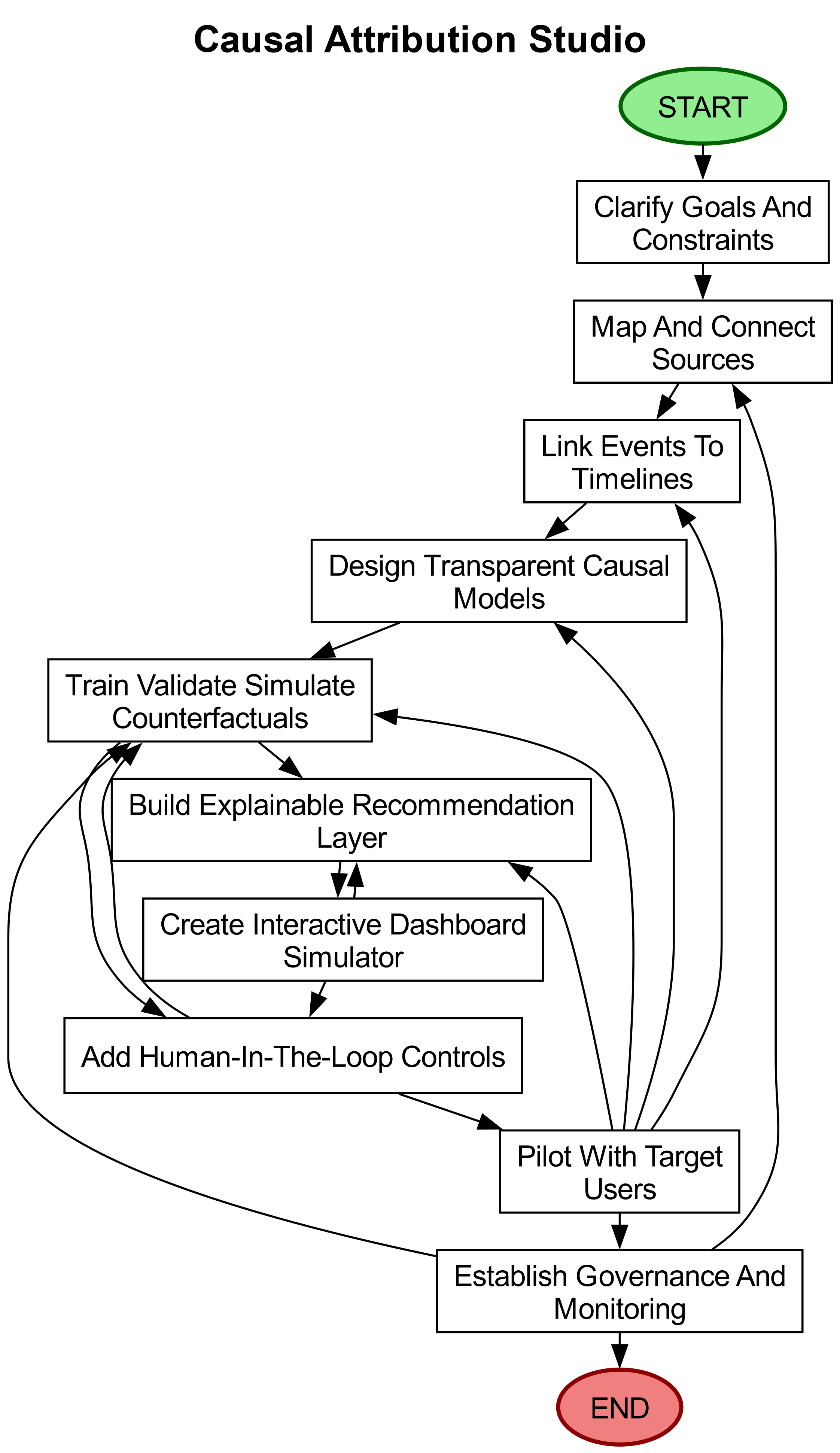
Clarify goals and constraints: Define key conversion events (e.g., purchases, signups), planning horizons (daily/weekly/monthly), privacy rules, and critical business questions (e.g., which channels drive incremental conversions?).
Map and connect data sources securely: Identify and integrate data from ad platforms, CRM, POS systems, and call logs while standardizing fields (e.g., customer ID, timestamps) and documenting consent.
Link events into customer timelines: Merge online and offline touchpoints into unified customer journeys using exact matches (e.g., email) or probabilistic linking, with confidence scores for each connection.
Design transparent causal models: Select interpretable methods (e.g., holdout groups, uplift models) and explain how each estimates causal impact—not just correlation—in plain language.
Train, validate, and simulate counterfactuals: Train models on historical data, reserve a validation period, and run “what-if” simulations to predict conversion changes under different budget scenarios.
Build an explainable recommendation layer: Translate model outputs into actionable steps (e.g., “Increase Channel X by 20%”) with human-readable explanations and example customer journeys.
Create an interactive dashboard and simulator: Display attribution results, confidence levels, and a scenario planner for testing budget shifts, with filters for segments and individual journeys.
Add human-in-the-loop controls: Enable specialists to review, annotate, and approve recommendations, with feedback loops to refine models and override options for campaign managers.
Pilot with target users and iterate: Test with a small user group and subset of campaigns, compare predictions to actual outcomes, and refine matching, modeling, and explanations.
Put governance and monitoring in place: Log model decisions, monitor data quality and performance, audit for privacy compliance, and set cost limits to control operational spend.
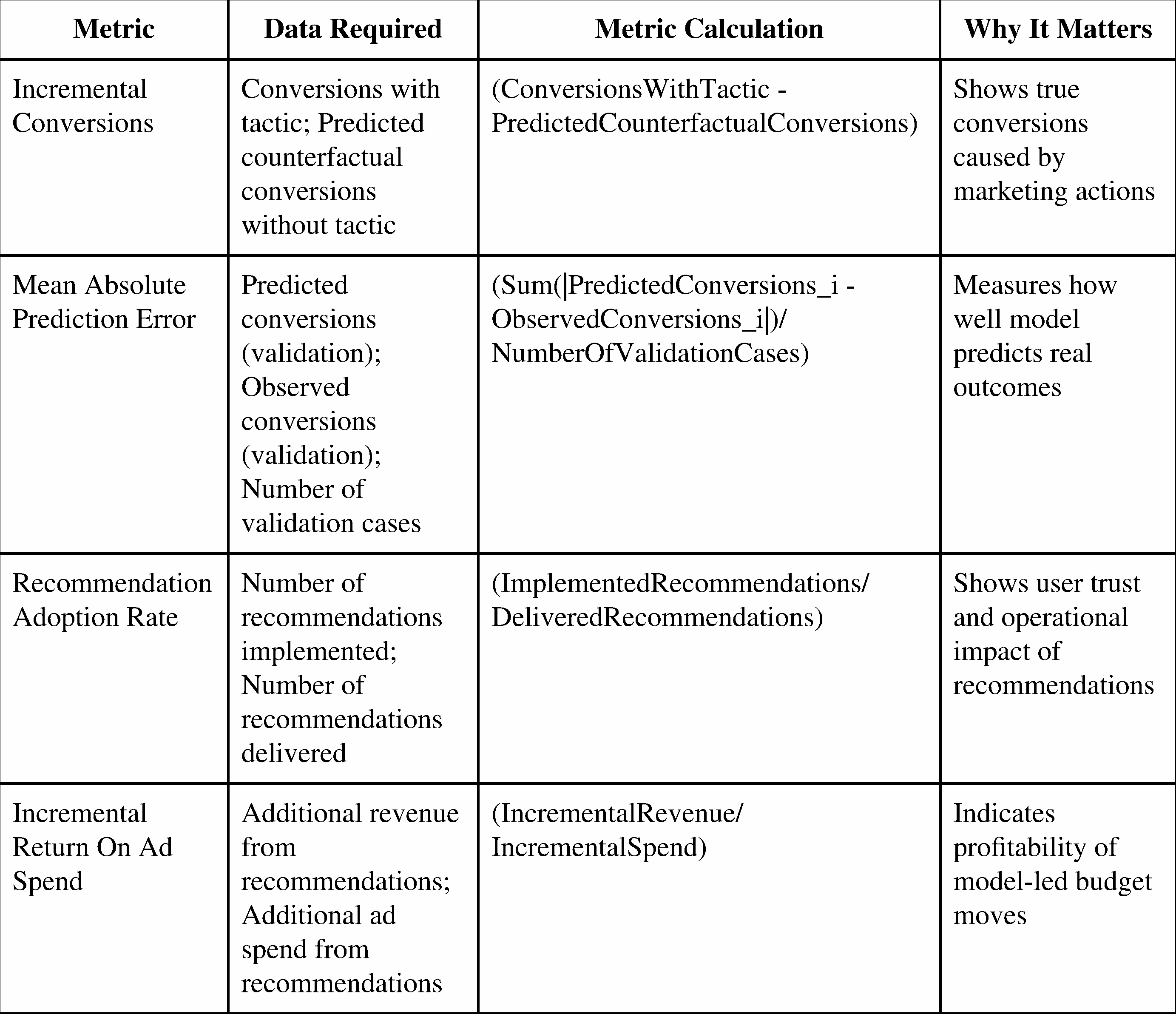
Impact Metrics
Human-in-the-Loop
Define objectives, success metrics, and data-linking permissions.
Clean and label data when automation fails, and validate customer record matches.
Review causal assumptions, approve budget recommendations, and provide pilot feedback.
Conduct periodic audits for privacy, fairness, and compliance.
Things to Watch For
Privacy risks: Combining online/offline data may expose sensitive information or violate consent rules if not carefully controlled.
Flawed causal conclusions: Incorrect assumptions or missing variables can lead to harmful budget shifts and wasted spend.
Operational complexity: Maintaining data links, models, and workflows requires ongoing resources and cost management.
Key Takeaways
Causation > correlation: Focus on incremental conversions to prove marketing impact, not just observed patterns.
Transparency builds trust: Explainable models and human oversight ensure recommendations are actionable and credible.
Start small, scale smart: Pilot with a limited scope to validate predictions before full deployment.
Disclaimer: The idea discussed here reflects a potential application of AI. It is intended for exploration and inspiration. Actual implementation may vary.